
In Pursuit of Achieving the ICH Q10 Objectives for the PQS Through a Systems Thinking Approach
Nearly 20 years after ICH Q10, the Pharmaceutical Quality System (PQS) still works mainly as a compliance system. Anders Vinther, John Atkinson and Dr. Janet Woodcock explain why linear, fix-it thinking can't close that gap, and how a systems thinking approach could deliver all three of its objectives.
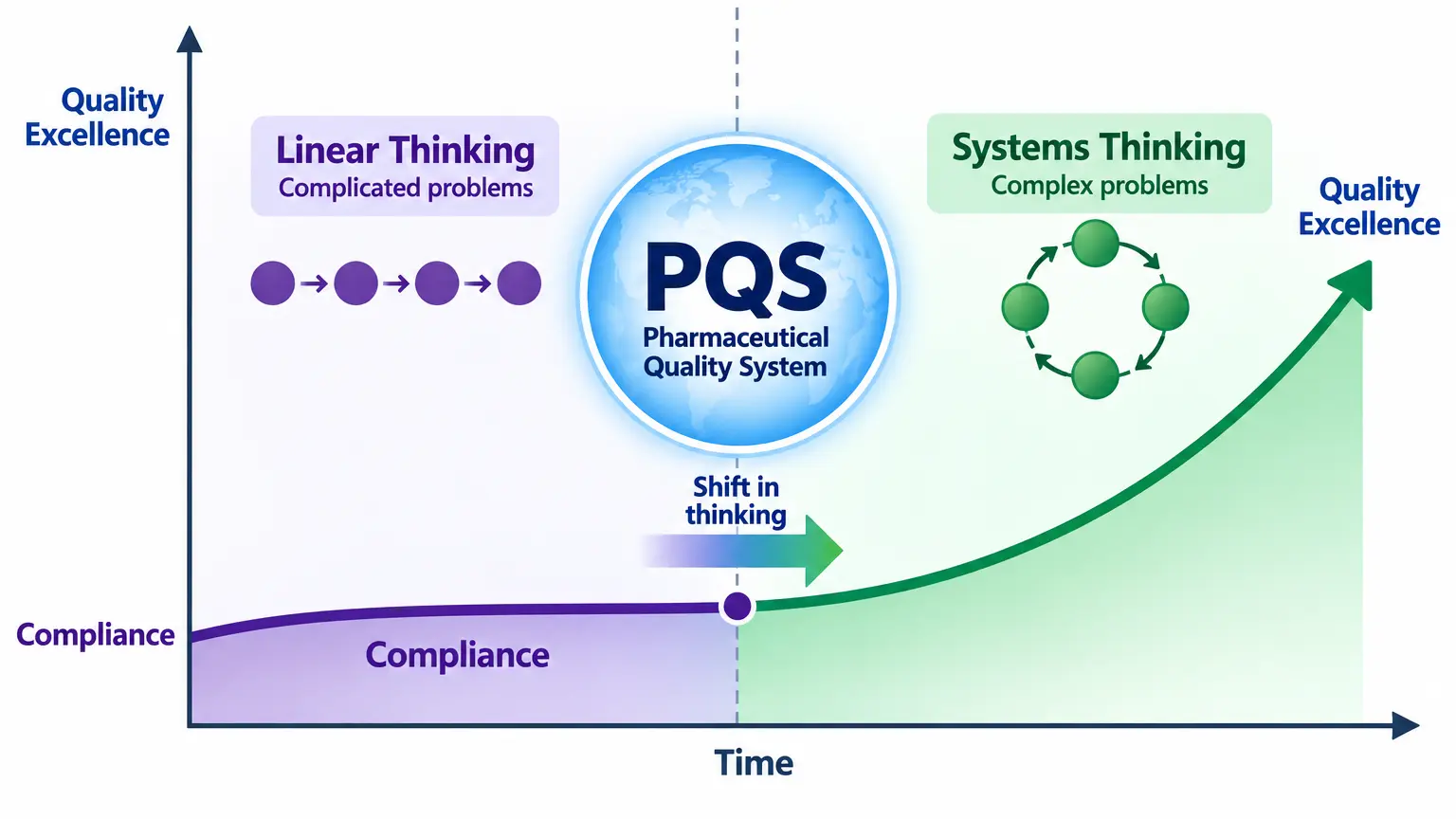
Not every problem is solvable. Treating every problem as though it can be may be the very thing keeping us from making meaningful progress. The words complicated and complex are often used interchangeably despite describing fundamentally different types of problems. Complicated problems can be solved through linear thinking; complex problems must be understood and influenced as a whole through systems thinking. That distinction matters for the Pharmaceutical Quality System (PQS), where decades of effort have yet to fully deliver the objectives set out in ICH Q10.
Let us consider the differences between a complicated problem and a complex problem.
Complicated Problems
Some problems have a known answer. They may be tricky to resolve, but by working through the process, you get to a solution. The problem is then fixed, and you can move on. There is an established link between cause and effect.
We refer to these situations as complicated problems. However tricky they may be, they are ultimately resolvable. This makes them well suited to linear thinking: breaking the problem into its constituent parts, isolating the cause and applying a solution.
Many issues in production systems work this way. Automation and mechanization create reliably reproducible actions. When these fail, you can identify what went wrong and resolve it. The process should then run reliably once more.
The complicated problem approach is ‘find the expert, deploy the process’.
Complex Problems
Some problems, however, don’t respond to being treated with this linear approach. They can be influenced but not fixed and need to be treated as a whole, not broken down into parts. We refer to these as complex problems.
These are typically problems where living things, like people, are involved. Highly networked relationships between people, organizations, products and means of production produce numerous interacting feedback loops, often operating over different timescales and across large geographies. There may be multiple causes for any effect, which means that what appears to be a single, isolated problem may actually be the result of many interconnected factors. Individual stakeholders often only see a tiny part of what is going on, and only from their own viewpoint.
Complex problems therefore don’t work the same way as complicated problems. There are characteristics found in the whole that are not found in any of the individual parts, and those characteristics drive the behavior of the parts. Simply improving one element in isolation is therefore unlikely, over time, to produce any noticeable shift in the characteristics of the whole because the wider system can adapt around that attempt to change, and continue to maintain its existing state. This is the dynamic equilibrium between a system and its environment. Just as a bird in flight adjusts its course to match any shift in the wind and stay on course, the wider system continually adjusts in response to changes while maintaining its purpose.
These complex problem characteristics require a different approach: systems thinking, which seeks to understand and influence the interconnected system as a whole rather than solve its individual parts.
The Complex problem approach is: ‘find the question, deploy the team’.
Linear Thinking vs. Systems Thinking: Why the Distinction Matters
Before approaching any problem, we must first distinguish what type of problem we are dealing with. That distinction determines how it should be approached.
The consequences of getting that distinction wrong become apparent when linear thinking is applied to a complex problem. Isolating a problem, identifying a cause and attempting to fix it may address only a small part of what is actually happening within the wider system. The intervention may bring some local benefit, but it can also generate a raft of unintended consequences elsewhere. You can ameliorate the problem or deteriorate it, but you cannot simply fix it. In fact, applying linear thinking to a complex problem can make it worse, not better.
The effort to reduce smoking illustrates the difference between the two approaches. Linear thinking might isolate one cause and apply a direct solution; for example, raising the cost of tobacco with the expectation that fewer people will smoke. A systems thinking approach recognizes that smoking is influenced by many interconnected factors and that no single intervention or stakeholder can eliminate it. Increasing the cost of tobacco, health information campaigns and other interventions can each influence the system and reduce smoking, but none can achieve the desired outcome on its own.
Applying Systems Thinking to the PQS
Applying a systems thinking lens to the Pharmaceutical Quality System means looking beyond its individual processes and considering the PQS as a system in its entirety.
If we look at the PQS as a ‘system’ then a good start point is to ask, ‘what is the purpose of this system?’ In other words, ‘what is it here for?’ ICH Q10 describes three objectives;
- Achieve product realization
- Establish and maintain a state of control
- Facilitate continual improvement.
Taking a systems perspective, Stafford Beer argued that ‘the purpose of a system is what it does’, not what it is intended to do. In other words, to understand a system’s true purpose, we need to look at the outcomes it actually produces.
When we look at the PQS system and ask what it actually does, we see a strong emphasis on maintaining control through rigorous internal and external inspection regimes focused on cGMP compliance. Noticeably less emphasis is placed on achieving product realization, characterized by the avoidance of drug shortages, and facilitating continual improvement. Plans and progress toward quality excellence—including learning, risk reduction and continual quality improvement—are often managed outside the PQS. This reflects a compliance mindset focused heavily on identifying problems, determining causes and implementing corrective actions to restore and maintain a state of control. In essence, the PQS is acting primarily as a compliance system.
The gap between the three objectives set out in ICH Q10 and what the PQS actually does is widely recognized among stakeholders. The issue has been known for decades, yet well-intended efforts, including additional guidance and continued discussion, have failed to meaningfully shift it.
Why Linear Thinking Has Not Shifted the PQS System
The fundamental issue is that this compliance mindset applied to the PQS assumes that all problems are ultimately solvable and that all problems can be approached with linear thinking, cause and effect. It does not first distinguish between complicated problems that can be solved and complex problems that can only be influenced; improved or deteriorated.
The compliance mindset encourages treating situations as complicated not complex. It sees adverse circumstances as things to be fixed, rather than improved or deteriorated. It sees problems as being addressed by splitting them into their constituent parts to find a root cause that can be resolved. Whilst this can be a highly effective tool for working with production processes, it breaks down when applied to problems of a different nature; complex problems. Working on one element of the situation or applying one individual stakeholder’s actions probably doesn’t change the whole, no matter how well intended, how much data is generated, or how many times attempted. The PQS is a complex system existing in, and interacting with, a complex and highly political environment with many stakeholders. Shifting what it does requires a systems thinking approach by stakeholders together.
To further illustrate that the linear thinking approach taken so far for the PQS has not achieved the desired result let’s look at the 2005 ICH Q10 Concept Paper in relation to post-approval changes (PACs). The Concept Paper states that the absence of an internationally harmonized pharmaceutical quality systems guideline can have a negative impact on the patient, regulator and/or industry including
- Delays may occur in the availability of medicines to patients around the world
- Delays in the implementation of innovation and continual improvement for existing products
- Delays in the launch of new products.
- Different approaches between the three regions to compliance inspections.
Two decades later, some of the benefits envisioned in the Concept Paper have yet to materialize, namely to “encourage industry to improve manufacturing processes” and “facilitate innovation and continual improvement”.
PACs provide a clear example of why a linear thinking approach falls short within the PQS system. ICH Q10 Annex 1 envisioned greater regulatory flexibility for companies that could demonstrate an effective PQS and strong product and process knowledge. Achieving this requires changes and coordination across a much larger system than a company itself can control, including the requirements, processes and decisions of multiple regulatory authorities across many countries. As a result, obtaining approval for the same PAC across all countries where a product is marketed most often takes years, rather than weeks or months. Regulatory flexibility is therefore not a complicated problem that can be solved through a single isolated initiative, but an outcome that depends on cooperation across the wider system. Today, nearly two decades after the ICH Q10 guideline was finalized and published (2008) there is still no regulatory flexibility incentive for companies demonstrating an effective PQS and product and process understanding.
Achieving the intended outcomes of ICH Q10 requires moving beyond linear thinking and approaching the PQS as a complex system. In practice, this requires several fundamental shifts.
Bring the wider system into the conversation
Evolving to a new state is the true definition of transformation. It requires working with the system as a whole rather than placing responsibility on individual parts. For the PQS, that means bringing together a broad representation of stakeholders, including chief quality officers, other pharmaceutical company leaders, regulators, political interests, patients, and health care providers to bring different perspectives, identify barriers and examine what previous attempts to solve the problem have taught us, including their unintended consequences.
Deliberately changing the narrative around quality
Human systems are characterized by narratives, shared stories that capture the beliefs and experiences of the participants. The current pharmaceutical quality ecosystem contains distinct sector-specific narratives. For example, many quality professionals profess that “compliance” is their primary objective, C-suite executives may believe that the quality function is a necessary evil in order to avoid regulatory delays and actions, politicians often lament that the industry can’t be trusted to maintain a high level of quality, and members of inspectorates may relate lurid stories of quality failures. These stories are shared within the sector and influence prevailing attitudes. A central role of quality business leaders must be to shift these narratives towards more balanced and forward-thinking approaches that are aligned with modern thinking about quality and illustrate the success of these principles for pharmaceuticals. This effort must be based on a solid understanding of how quality is achieved and maintained, because this foundation provides a credible basis for advocating for change. Quality business leaders will need to call out and challenge the assumptions underlying the current narratives and provide alternative, evidence-based stories that illustrate a better way to conceptualize the various parts of the problem.
Experiment toward a better state
Moving to a new state means moving into the unknown, so the solution cannot be designed in advance or by one isolated group within the wider system. The desired outcome must first be clear to everyone. From there, progress comes through small, safe-to-fail experiments: introduce targeted changes, observe how the wider system responds, including any unintended consequences. What is learned should inform subsequent experiments, allowing different stakeholders to build on one another’s experience and collectively adapt their way toward the desired state.
Create a safe and shared process for learning
What is learned should inform subsequent experiments, allowing the system to progressively adapt its way toward the desired state, without fear of reproach or recrimination. This should include not only what works and what does not, but how the wider system responds and what unexpected effects emerge.
Make it easy for others to participate
The learning should be accessible so others can apply it, conduct their own experiments and contribute their results. Broad participation is critical: approaches that are too rigid or controlled by those at the center can discourage others from joining even though valuable innovation often emerges at the fringes.
These principles also give us a framework for identifying where practical change to the PQS could begin:
Define what good looks like. Discuss and establish the outcomes that would demonstrate achievement of the ICH Q10 objectives and provide a common direction for efforts across the system. This can start with a defined vision and concept paper created by industry quality business leaders, which would then be brought into a conversation involving all key stakeholders.
Broaden how we assess the PQS. Changing the narrative around quality can start with an expansion of the PQS assessment beyond compliance to include continual improvement, product realization and quality culture. Expanding the scope of Management Review (MR) could provide a practical starting point.
Incentivize companies demonstrating an effective PQS and quality excellence. Experimenting towards a better state can include implementation of the PIC/S recommendation paper for risk-based change management as well as including more continual improvement, supply robustness and quality culture assessment in the company MR. Companies striving for quality excellence go beyond basic cGMP compliance and constantly have projects and activities towards a better state. Regulators and companies can create a safe and shared process for this learning and not create the unintended consequence of the PQS continuing to be a compliance system only by incentivizing companies that demonstrate an effective PQS with respect to all the originally intended ICH Q10 objectives.
Next steps
ICH Q10 is approaching its twentieth anniversary. Remember ‘the purpose of a system is what it does’. We know what it was intended to achieve. We also know what it does. It does compliance. The challenge, and the opportunity, now belongs to all of us who shape the system: to turn that intent into reality. That means moving beyond improving individual parts of the system and addressing how those parts interact, across functions, organizations, incentives, and regulatory boundaries. If we want different outcomes, we must be willing to work together to change the assessment of the system that produces them.